
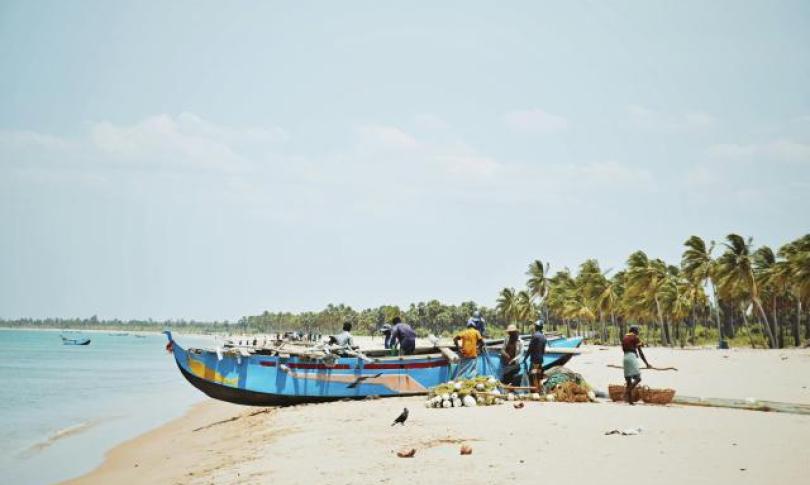
As the first light of day breaks over Ghana’s coastline, life stirs much like it has for generations. Fishermen push wooden canoes into the Atlantic. Women prepare baskets for the morning catch. Children follow, eager to help and learn. Yet beneath this familiar rhythm lies a growing unease. Climate change is steadily unraveling the social, economic, and environmental fabric of Ghana’s coastal communities.
From fishing villages to tourist towns, the impacts are no longer just warnings from scientists. They are realities faced daily by people whose lives depend on the sea.
Denis Worlanyo Aheto, a professor of Coastal Ecology and Interdisciplinary Oceans Studies at the African Centre of Coastal Resilience at the University of Cape Coast, links the changes to rising sea levels, stronger storms, and human activity.
“The West African coastal erosion is driven by climate change, sea-level rise, storms, and human activities such as sand mining and dam construction. To overcome this, we need integrated, high-tech solutions like satellite monitoring and early warning systems, along with local adaptation strategies and management plans to protect vulnerable communities and ecosystems.”
A livelihood under threat
Fishing has long been the backbone of coastal Ghana, which stretches roughly 539 to 550 kilometres from the southwestern border with Côte d’Ivoire to the east. The artisanal fisheries sector operates across 304 landing sites in 189 fishing communities, supporting an estimated 1.5 million livelihoods. Fishermen, fish processors, traders, boat builders, net menders, and transporters all rely on it. For many families, fishing is not just work; it is part of their identity.
Today, that identity is under severe strain. Rising sea temperatures are changing marine ecosystems, while shifting ocean currents are pushing fish stocks further offshore. Species that once arrived predictably are now scarce or have vanished altogether.
“In the past, we understood the sea,” says Ebo Eshun, a fisherman in Elmina with more than three decades of experience. “Our fathers taught us when to go fishing, where the fish would be, and how the winds behaved at each time. That worked for us in the past. Now everything has changed. The sea tricks us nowadays.”
Fishermen report spending longer hours at sea, burning more fuel, and taking greater risks, only to return with smaller catches. The financial impact is severe. Meeting school fees, medical bills, and daily household needs is becoming increasingly difficult. Debt is now common.
In 2020, the government introduced closed fishing seasons to allow fish stocks to recover. While scientists support the measure, many fishermen say it has worsened short-term hardship without delivering visible gains.
“We stayed at home when they told us to,” Eshun says. “But when we went back to the sea, the fish hadn’t returned. Hunger doesn’t understand policies.”
The Ministry of Fisheries and Aquaculture Development insists the hardship is temporary and aims to restore marine ecosystems so that the nearly three million people who rely on the sector can maintain their livelihoods.
The policy, backed by the Fisheries Act, 2002 (Act 625), is designed to allow fish to reproduce and juveniles to mature, replenishing depleted stocks. Sector Minister Emelia Arthur has stated that the policy “must be adhered to for the benefit of all.”
Salty soils and shrinking harvests
Beyond fishing, climate change is undermining coastal agriculture. Rising sea levels are pushing saltwater into freshwater systems, contaminating wells and flooding farmlands. Even small increases in salinity can make soil infertile.
In the Ada East District, once-productive farmlands now stand abandoned. Farmers report seawater creeping inland during high tides, leaving behind a salt crust that kills crops.
“This land used to grow maize, okra, and pepper,” says Ama Odartey, a small-scale farmer in Kualedor. “Now the plants die before they can even grow. The soil is poisoned.”
For families relying on both fishing and farming, the double impact has worsened food insecurity. Women, who play a key role in farming and fish processing, are among the hardest hit. Many are now forced to buy food they once produced themselves.
Experts warn that severe soil salinization is already affecting food security in coastal areas such as Afife, Anloga, and Ada, driven by poor irrigation practices, overuse of fertilizers, and rising sea levels pushing saltwater inland.
“The impacts of climate change extend beyond the water’s edge,” explains Edward Yeboah, Director at the Council for Scientific and Industrial Research (CSIR). “Rising sea levels are pushing saltwater inland, contaminating freshwater sources and farmlands. In low-lying coastal districts like Ada East, farmers watch their fields turn white with salt.”
Homes swallowed by the sea
Along Ghana’s 550-kilometre coastline, erosion is forcing families to rethink futures once assumed secure. For many, rebuilding is no longer an option.
“At my age, how do I rebuild a roof over my family?” asks 79-year-old Zanu Adzaho, a canoe owner at Shama Beach, one of the areas hardest hit by tidal waves. “I guess that’s the end of the road for us.”
Perhaps the most visible and traumatic effect of climate change is the destruction of homes. Accelerated coastal erosion, fueled by rising seas and stronger waves, is reshaping the shoreline relentlessly.
In Totope, located in the Ada West District, residents have watched the sea advance metre by metre.
“We have moved three times,” says 68-year-old Torgbui Lomotey. “Each time we think we are safe, the sea comes again. How many times can a person start over?”
Similar stories ring out across Fuveme and Akplorwotokor in the Anloga District, and along parts of Greater Accra and the Central Region. Children grow up learning evacuation routines alongside their school lessons. Families sleep lightly during storms, tuning in for waves breaking too close for comfort.
Tourism falters along the shore
Ghana’s palm-lined beaches and historic coastal towns have long attracted tourists, supporting hotels, restaurants, and tour operators. But climate change is making these destinations more fragile.
In Axim, located in the Western Region, erosion and frequent storm surges have eroded beaches and damaged seaside infrastructure.
“Guests used to come for the peace and the beach walks,” says Nana Abena, who runs a small guesthouse in Tikobo No. “Now they ask if it’s safe, if the road will flood, if the beach will still be there tomorrow.”
With fewer visitors, incomes have declined sharply. Young people who once worked in tourism are migrating to cities, leaving behind aging communities and closed businesses.
A shared Gulf of Guinea crisis
Ghana’s experience is part of a larger Gulf of Guinea challenge. Countries across the region face similar threats, especially in areas where sea defenses are weak or lacking. Scientists warn that without urgent adaptation measures—like restoring mangroves, planning sustainable coastal developments, and strengthening defenses—some communities may become uninhabitable within decades.
A 2019 outlook report by Gavazzi of the USDA Southeast Climate Hub predicts that salinization will worsen as sea levels rise, pushing saltwater further inland and decreasing the profitability of traditional farming practices.
The Ghanaian government states it is responding. In his recent State of the Nation Address, President John Dramani Mahama mentioned ongoing sea defense projects in the Volta, Greater Accra, and Western regions, including armor rock revetments and groynes.
“Key initiatives include the Blekusu Phase II project and other coastal protection works aimed at securing communities and infrastructure from rising tidal waves and sea-level rise.”
While affected communities are demanding clear timelines to prevent project delays, the government expects completion between 2028 and 2029.
For now, residents continue to adapt as best they can, relying on resilience developed over centuries. But as Professor Aheto notes, resilience has its limits.
“We are not asking for charity,” says Akune Mensah in Aboadze, watching the horizon darken before a storm. “We are asking to survive. The sea gave us life. Now we need help to live with it again.”
As climate change tightens its grip, the fate of Ghana’s coast is no longer just a local concern. It is a human story—of livelihoods under threat, homes lost to the waves, and communities standing on the frontline of a global crisis whose tide continues to rise.